Buying guide · Women's safety footwear
The most common women's safety-boot experience is a size 5 men's boot, a heel that lifts with every step, and blisters by Wednesday — followed by trainers on Thursday, which is how bad fit becomes a safety incident. The fix isn't a smaller boot; it's a boot built on a different shape.

The problem
A boot is built around a last — the foot-shaped form that sets its internal geometry — and a typical women's foot differs from a scaled-down men's foot in ways length can't fix: narrower heel relative to the forefoot (the anatomical mismatch behind heel slip), lower instep volume (why downsized boots feel cavernous however tight the laces), and different proportions through the arch. Put a female foot in a small men's last and the heel pistons, friction builds, blisters follow — and lacing harder just moves the pain. A women's-last boot changes the shape, not just the size, and the difference is felt in the first hundred metres.
What doesn't change: the certification. Women's-last boots carry the same S1P/S3 codes, the same 200 J caps and midsoles (2022 codes included). Availability has genuinely improved — proper ranges exist across site boots, trainers and wellingtons — so the fallback of 'we could only get men's' rarely survives an actual search, and the fit-is-safety argument gives the buying meeting its teeth. Buying advice that works: try boots late in the day (feet swell), in the socks you'll wear, and judge heel hold walking on an incline if you can find one — that's where slip announces itself.
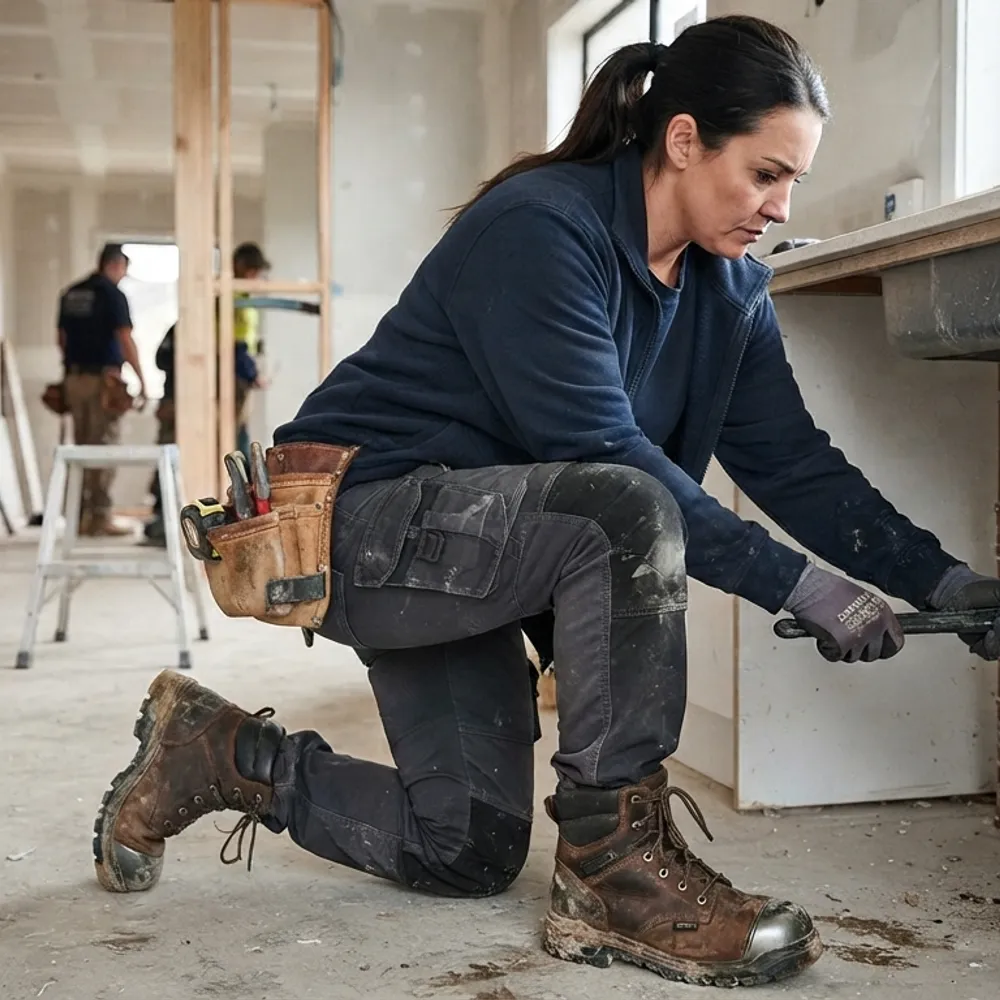
The check
| Test | Pass looks like |
|---|---|
| Heel hold on an incline | No lift or piston — the single best predictor |
| Toe clearance | Wiggle room; toes never brush the cap |
| Instep snugness | Laced firm without crushing — no cavernous volume |
| Width at the ball | Flex the foot: no pinch, no slop |
| End-of-day sizing | Fitted late day, in real work socks |
Questions
Good ones aren't — they're built on women's lasts with a narrower heel-to-forefoot ratio and lower instep volume, which is what stops heel slip and blistering. Downsized men's boots keep men's proportions and cause most of the fit misery women report in safety footwear.
Identical where the codes match — S1P is S1P and S3 is S3 regardless of last, with the same 200-joule toe caps and midsole tests. The certification doesn't distinguish; only the internal shape does.
PPE must fit the wearer — supplying only men's-last footwear doesn't meet that duty when fit is compromised, and women's-last ranges are now genuinely available across boot types. Raise it with the fit-is-safety argument; it's an ordering change, not a special request.
Everything in these guides is stocked, embroiderable and priced for teams.