Buying guide · Corporate & front of house
Front-of-house kit is the uniform customers actually look at — reception desks, restaurant floors, showrooms, salons. It has to read sharp at hour nine of a shift, wash at home without a dry-cleaning bill, and fit a team you didn't get to hand-pick. That's a different buying problem from a catalogue suit.

The buying problem
The catalogue photo is not the test. The test is a receptionist's blouse after five wears and five washes, a maître d's jacket at the end of a double, a showroom skirt that's been sat down in two hundred times. Buy front-of-house kit on three questions: does it wash at home (dry-clean-only tailoring quietly adds hundreds a year per person), does it recover (crease-resistant and stretch fabrics read pressed at hour nine), and does the colour hold — because a faded navy next to a fresh navy looks worse than either alone.
Fabric answers most of it: poly-wool and technical poly blends for tailoring, polyester-rich blouse and dress cloths with a touch of elastane, and skirt weights heavy enough not to cling. Pure natural fibres look wonderful on day one and lose the plot by month three of commercial laundering.
One team, one palette: pick the colour story once and buy every garment — tailoring, blouses, dresses, skirts — inside it, so any mix on any body still reads as the same uniform.
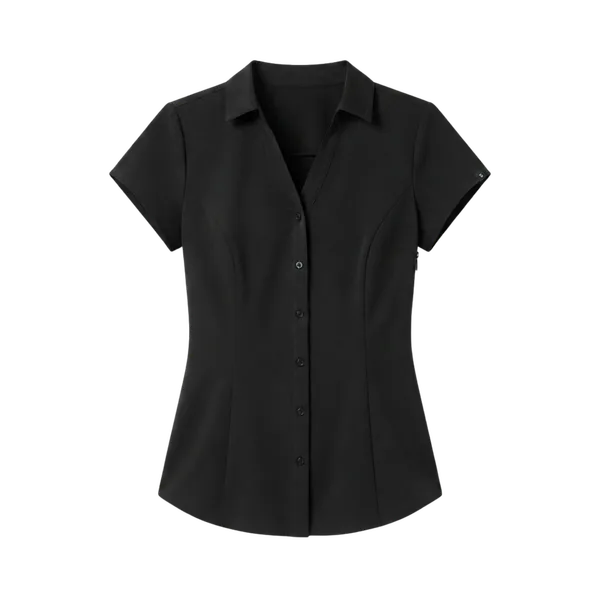
The checklist
| Garment | Check before ordering | Why it matters |
|---|---|---|
| Suits & tailoring | Machine-washable cloth; part-elastane; matching separates sold openly | Home-washable tailoring kills the dry-clean bill; separates let you fit real bodies |
| Blouses & shirts | Easy-iron or non-iron finish; cut generous across the back | The garment ironed at 6am must look ironed at 6pm |
| Dresses | Ponte or heavier jersey; sleeve option in the same style | Thin jersey clings and creases; sleeves widen who'll happily wear it |
| Skirts | Lined, mid-weight, with stretch; more than one length offered | Unlined skirts static-cling to tights; one length never fits a whole team |
| Ties, scarves & accessories | Brand colour available on repeat, not one season | Accessories are the cheapest uniform refresh — if you can reorder them |
Buying logic
Questions
Poly-wool or technical polyester blends with a small elastane content for tailoring, and easy-iron polyester-rich cloths for blouses and dresses. The blend does three jobs natural fibre can't sustain in shift work: home washability, crease recovery through a long day, and colour that stays matched across the team through repeat laundering.
Avoid it wherever possible. Dry-clean-only tailoring either costs the business a recurring laundering bill or quietly stops being cleaned properly. Machine-washable suiting is widely available now and looks the part; specify it and the problem disappears at the buying stage.
Fix the palette and buy every garment style inside it, from the same supplier range, so navy is the same navy across a suit, a dress and a skirt. Then offer real choice within the palette — trouser or skirt, dress or blouse, sleeve options — so people wear what suits them and everyone still matches.
For the employer, workwear provided to staff is a normal business expense. For employees required to wear and launder a recognisable uniform, HMRC's flat-rate uniform allowance may apply — see our uniform tax relief guide for how the claim works.
Everything in these guides is stocked, embroiderable and priced for teams.