Comparison · Over-garments
The tabard and the apron solve the same problem — protect the clothes, carry the kit, signal the role — with different geometry. One covers front and back and reads as uniform; the other covers the front and reads as task-wear. Most buying mistakes come from ignoring that split.

The comparison
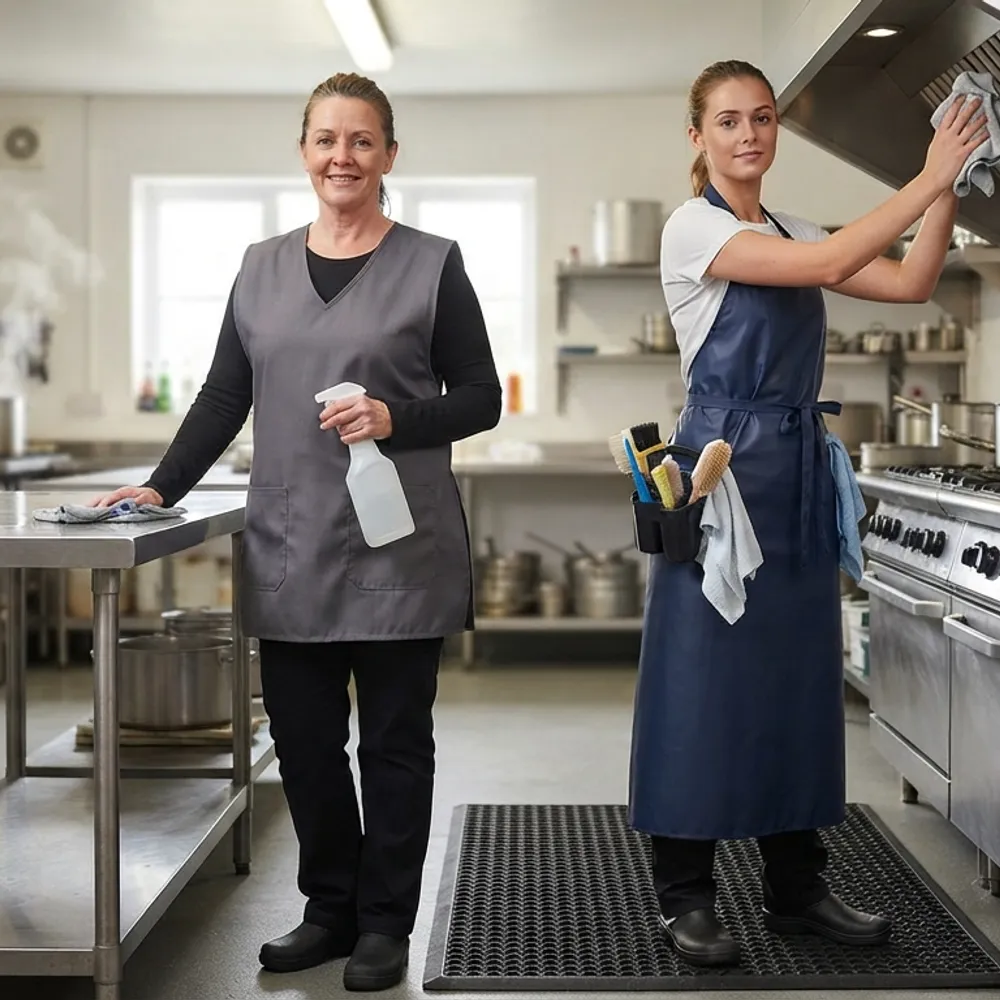
A tabard is a slip-over panel garment — front and back coverage, fastened at the sides, usually with big front pockets. Because it covers all round and stays put without ties, it wears like uniform: housekeeping and cleaning teams, dinner ladies, retail and care assistants — roles that move, bend and carry all shift, where a tie-back apron would work loose and where the pockets (cloths, spray, phone, notepad) do half the job. It also embroiders well front and back, which is why it doubles as brand-wear in cleaning & FM.
An apron is front-only protection, tied or halter-necked, in weights from waiter's waist-apron to butcher's heavy bib. It's task-wear: kitchens and food prep (chef kit pairs bib aprons over whites), salons mixing colour, workshops gluing and finishing. Aprons swap fast between tasks, launder hard, and in wipe-clean and waterproof materials handle the wet and bloody trades a fabric tabard can't. The split writes the rule: all-shift roles wear tabards; per-task protection wears aprons.
The sort
| Role | Garment | Why |
|---|---|---|
| Cleaners & housekeeping | Tabard | All-shift wear, pockets do the carrying — the cleaner's kit |
| School catering & care assistants | Tabard | Uniform-grade coverage that stays put |
| Chefs & kitchen porters | Apron (bib) | Task protection over whites, swapped per service |
| Salons & barbers | Apron | Colour chemistry — salon kit |
| Butchery & wet trades | Waterproof/heavy apron | Wipe-clean weights no tabard offers |
Questions
Coverage and fastening: a tabard slips over the head and covers front and back, fastening at the sides — it wears like uniform and usually carries big pockets. An apron ties on and protects the front only, from waist styles to heavy bibs — it wears like per-task protection.
Because the job is all-shift and mobile: a tabard stays put through bending and reaching without ties loosening, covers clothing front and back, and its pockets carry cloths, sprays and phones. It also takes embroidery well, so it doubles as the team's identifiable uniform.
Wipe-clean and waterproof materials — polyurethane and similar — for butchery, fishmongery and washdown tasks, with colour-coding where kitchens separate raw and cooked. Fabric bib aprons suit dry front-of-house and general prep, laundering with the whites.
Both sides of every comparison are one click away — or ask a human to settle it for your team.