All guides / Comparison
Comparison · Branding
Embroidery vs print for branded workwear.
Every uniform order hits this fork. The good news: it's rarely a matter of taste — the garment, the wash cycle and the design usually make the decision for you.
Comparison · Branding
Every uniform order hits this fork. The good news: it's rarely a matter of taste — the garment, the wash cycle and the design usually make the decision for you.
How each works
Embroidery stitches the logo into the garment — thousands of threads through a stabilised patch. It reads premium, holds colour for the garment's life, and shrugs off the industrial laundering that kills lesser branding. Its limits: fine gradients and small text turn to mush in thread, big designs get heavy and stiff, and needles perforate whatever they pass through.
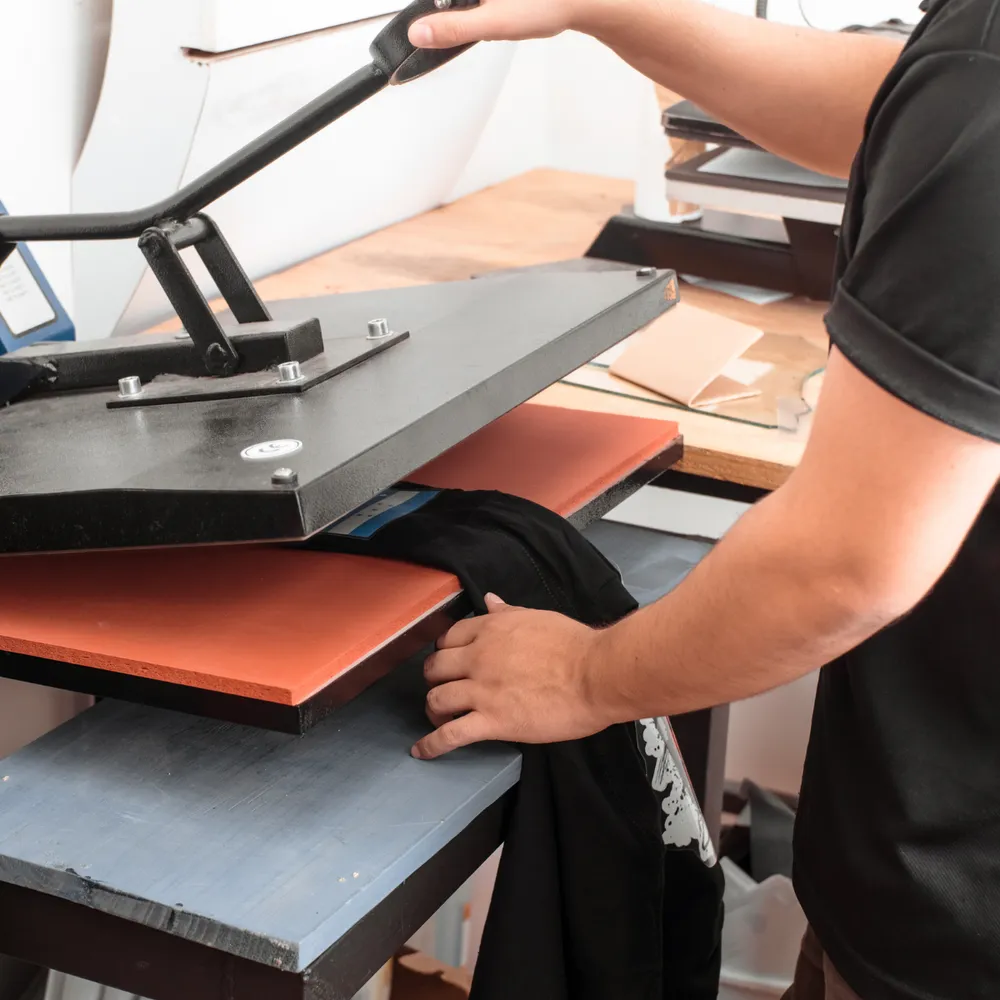
Print (heat-applied transfers and direct methods) bonds a film to the surface. It renders detail and gradients perfectly, scales to full-back designs, and — critically — doesn't puncture waterproof membranes or insulation. Its weakness is heat and flexing over time: hot washes and tumble-drying age it, edges lift, folds crack.
The decision
| Garment / need | Use | Because |
|---|---|---|
| Polos, sweats, fleeces — washed hard, worn daily | Embroidery | Stitching outlasts hundreds of cycles |
| Waterproof shells & padded jackets | Needles compromise membranes and fill | |
| Full-back designs, gradients, small text | Detail and scale thread can't render | |
| Hi-vis garments | Either — placed correctly | Decoration must stay off certified areas |
| FR garments | Supplier-applied only | Threads, films and process must be FR-compatible |
| Tight budget, short garment life | Cheaper per unit on kit that won't see 100 washes |
In practice
Questions
For garments washed hard and often — polos, sweatshirts, fleeces — embroidery, which outlasts print by hundreds of cycles. For waterproof shells (needles perforate membranes), large back designs and fine detail, print. Most fleets sensibly use both across the wardrobe.
Every stitch is a needle hole through the waterproof membrane. Some makers seal small embroidered areas, but the standard answer for rated rainwear is a heat-applied transfer, which bonds to the surface without puncturing anything.
It can if done carelessly. On hi-vis, decoration must stay clear of the certified fluorescent and tape areas; on FR garments, threads and processes must be FR-compatible. Both are reasons to brand safety kit through the workwear supplier rather than a generic print shop.
Both sides of every comparison are one click away — or ask a human to settle it for your team.