Comparison · Safety footwear
The toe cap doesn't care what's above it: a safety trainer's 200 joules equals a boot's. What differs is everything around the cap — ankle cover, weather resistance, weight, heat — and the right choice tracks the ground you stand on, not the aesthetics either camp argues for.

The comparison
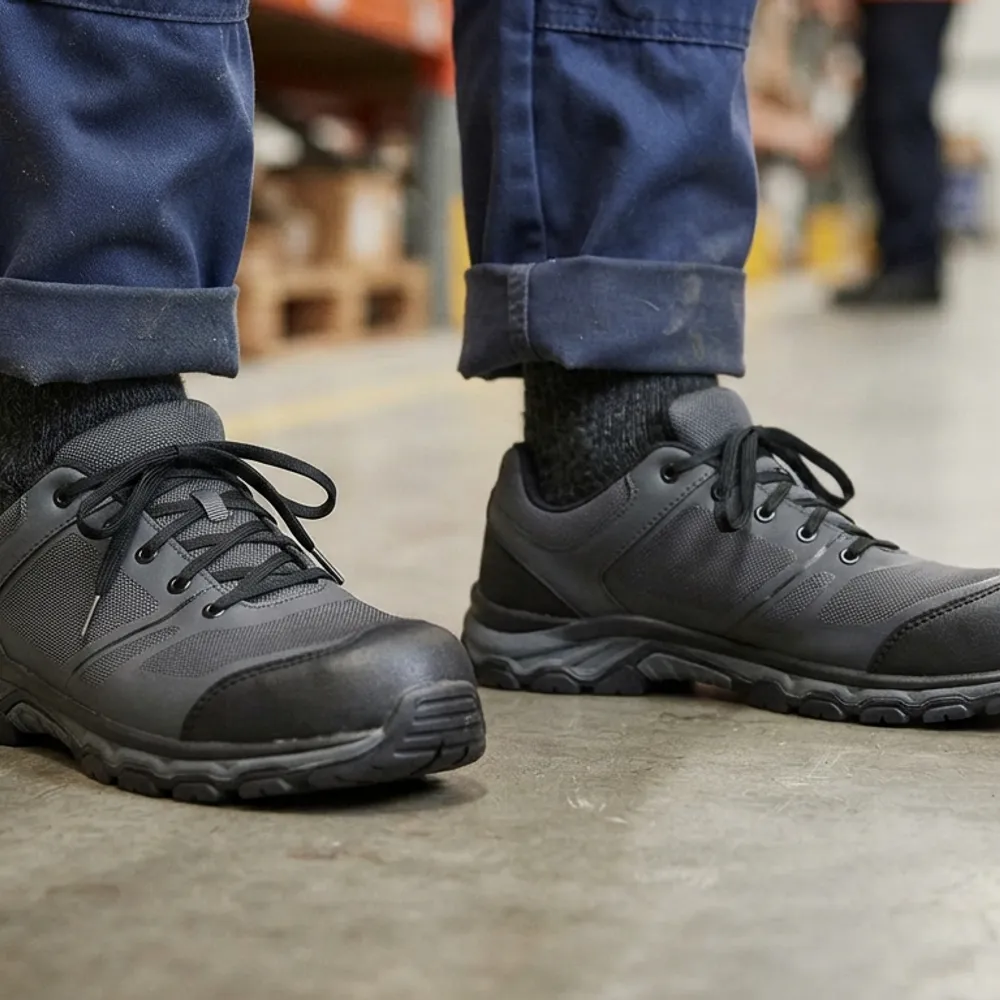
The trainer's case is distance and heat: tens of kilometres per shift on flat concrete favour a light, cushioned, breathable build — it's why logistics standardised on S1P trainers and why foot fatigue (and the absence it causes) drops when fleets switch. The boot's case is ground and cover: uneven surfaces, mud, debris and weather favour ankle support, a water-resisting upper and a lugged sole — plus the unglamorous protection of leather height against scrapes, sparks and the kicked-up hazards of open sites.
The ankle-support argument deserves honesty: a boot doesn't immobilise an ankle like a brace, but height and lacing measurably steady the joint on rough ground, and site managers see the difference in twist injuries. On flat floors that benefit largely evaporates — which is the whole decision in one sentence: flat and dry favours trainers; rough and wet favours boots. Codes follow the same split: trainers live at S1P, boots span S1P to S3.
The sort
| Worker | Better call | Why |
|---|---|---|
| Warehouse pickers & FLT | Trainers (S1P) | Kilometres on concrete; heat builds in boots |
| Construction & groundwork | Boots (S3) | Ankle, weather and debris cover |
| Delivery drivers | Trainers or hybrid mid-cut | Cab-to-doorstep repetitions favour light |
| Landscapers & outdoor trades | Boots (S3) | Rough, wet, uneven — the boot's home fixture |
| Workshops & MOT bays | Either — floor decides | Dry flat concrete makes it preference |
Reality checks
Questions
Toe and midsole protection can be identical — the codes measure the same tests. Boots add ankle cover, weather resistance and rough-ground stability that trainers genuinely lack; trainers add lightness and breathability boots can't match. Safety equivalence depends on where you work, which is why site rules sometimes mandate boots.
Because the environment plays to their strengths: flat dry concrete, long walking distances, indoor heat — conditions where cushioning and weight matter more than ankle cover and weatherproofing. S1P safety trainers became the logistics default for exactly those reasons.
They steady it rather than brace it — height and firm lacing measurably reduce roll-over on uneven ground, which is where the injuries happen. On flat floors the advantage mostly disappears, so the ankle argument is really an argument about your terrain.
Both sides of every comparison are one click away — or ask a human to settle it for your team.