Comparison · Healthcare & care
Care providers rarely agonise over this one — their workflow has usually already decided it. But if you're setting up fresh or reviewing uniform policy, the fork is worth understanding properly, because swapping later means re-kitting everyone.
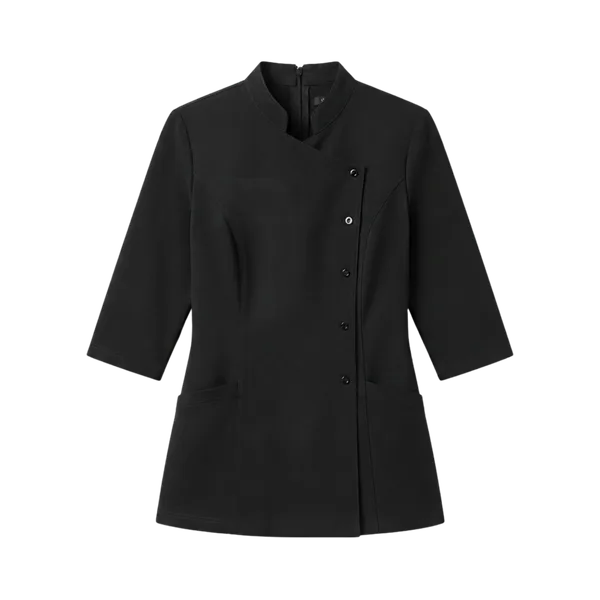
The fork
Scrubs grew up in hospitals: loose, unisex, pocketed two-pieces designed to be changed into at work and pooled through hot laundry. Nobody owns "their" scrubs in a theatre suite; sets circulate. They're cheap per set, cut for movement, and anonymous by design.
Tunics come from the clinic side: structured, fitted, worn over your own trousers, owned by the wearer and presented to the public all shift. Piping and trim colours code the role — the difference between a nurse, a senior carer and housekeeping at a glance down a corridor — and they hold their shape through a 12-hour shift in a way a scrub top doesn't try to.
Head to head
| Your situation | Points to | Why |
|---|---|---|
| On-site changing, pooled laundry | Scrubs | Built for exactly that cycle |
| Public-facing all shift (care home, clinic) | Tunics | Structure and role colour-coding |
| Domiciliary rounds | Tunic or polo | Presentable at the door, layers for the car |
| Role identification matters to residents | Tunics | Trim colours read instantly |
| Tight budget, high garment turnover | Scrubs | Cheapest compliant sets to rotate |
| Mixed estate (clinical + FOH) | Both | Scrubs behind the doors, tunics in front |
The constants
Whichever side of the fork you take: the fabric must survive the laundering policy (commonly a 60 °C benchmark — poly-cotton blends built for it), bare-below-the-elbow policies favour short sleeves during care tasks, staff need three to five sets for the rotation to actually work, and footwear does half the comfort of a long shift. The full employer-side picture is in the healthcare sector guide.
Questions
Scrubs are loose pooled two-pieces built for on-site changing and hot communal laundering; tunics are structured, personally-issued garments worn over your own trousers, with trim colours that code roles for residents and visitors. Workflow — pooled vs public-facing — decides it.
Yes, and some do, particularly for night staff and heavy-care units. The trade-off is presentation: tunics read as professional and colour-code roles at a glance, which matters where families and residents interact with staff all day.
Three to five, assuming a wash after every shift as most policies require. Under-issuing is the most common failure — one soiled shift with two sets breaks the rotation and the policy with it.
Both sides of every comparison are one click away — or ask a human to settle it for your team.