Comparison · Safety footwear
S1P and S3 are the two codes that sell nine safety boots in ten, and the difference is smaller than the argument suggests: both protect the toe (200 J) and the sole (puncture midsole). S3 adds a water-resistant upper and a cleated outsole. That's it — which is why the choosing rule fits in one line: S1P works indoors, S3 works everywhere.

The comparison
Read the code ladder and the pair sit close together: S1P = antistatic, energy-absorbing heel, fuel-resistant sole, 200 J toe, Penetration-resistant midsole. S3 = all of that plus a water-penetration-resistant upper and a cleated outsole. (The 2022 update splits each by midsole type — S1PL/S1PS, S3L/S3S — without changing this logic.)
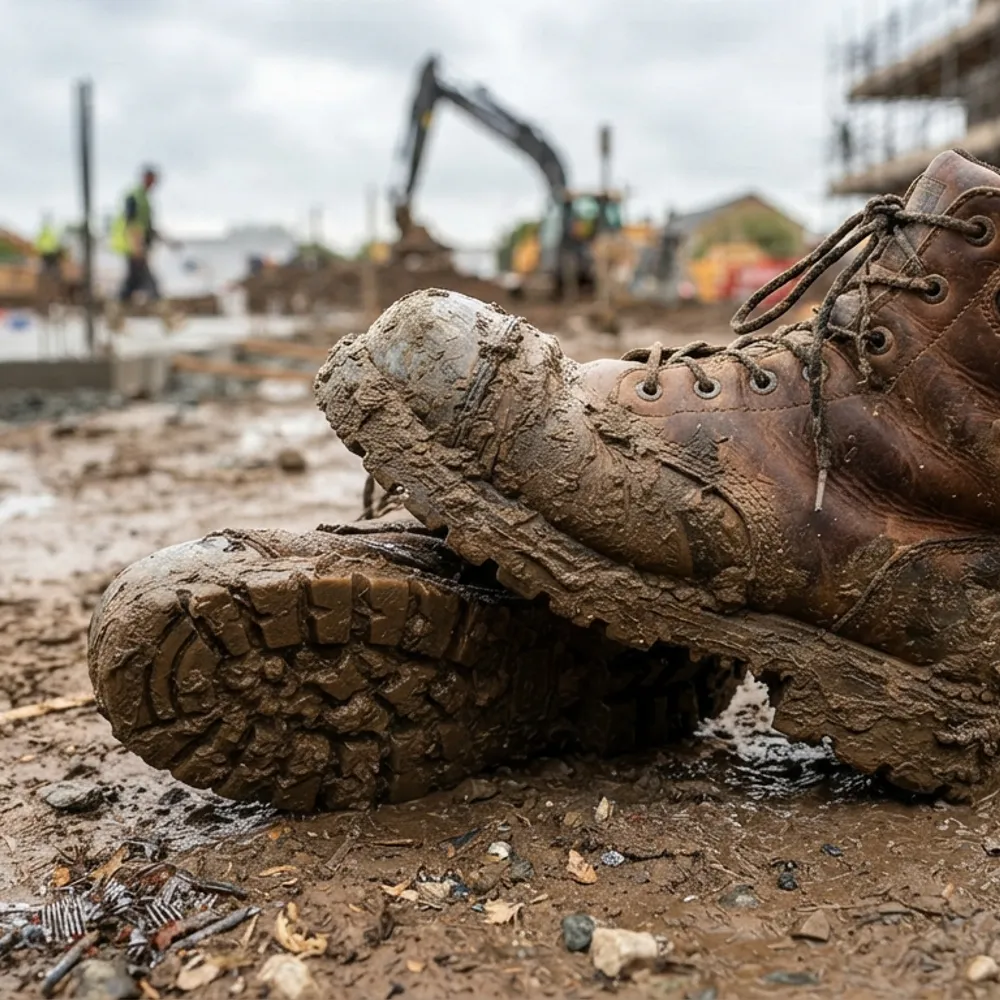
The practical consequences: S1P builds lighter — often trainer-style, breathable, made for the 15 km a picker walks on dry concrete — while S3 builds for ground: leather or treated uppers that shrug off wet grass and mortar slurry, lugs that bite mud. Wear S3 all day in a hot dry warehouse and you're carrying weight and heat for weather that never comes; wear S1P trainers on a winter groundworks job and you're wet by nine and cold by ten.
The honest asterisk: water-resistant isn't waterproof — S3 resists penetration; standing water eventually wins. Genuinely wet work moves to waterproof-lined boots (the 2022 edition's S7 territory) or safety wellingtons.
The decision
| Environment | Code | Why |
|---|---|---|
| Warehouse, factory floor, workshop | S1P | Light, breathable, midsole against dropped fixings and swarf |
| Construction site, groundworks | S3 | Mud, wet and rough ground — upper and tread earn it |
| Landscaping & outdoor trades | S3 | The weather is the workplace |
| MOT bays & indoor automotive | S1P | Dry floors; metal-free versions clear inspection pits nicely |
| Permanently wet ground | Waterproof-lined or S5 wellington | S3 resists water; it doesn't promise to exclude it |
Questions
Both have a 200 J toe cap and a penetration-resistant midsole. S3 adds a water-penetration-resistant upper and a cleated outsole for grip on soft ground. In practice: S1P suits dry indoor floors and builds lighter; S3 suits outdoor sites and weather.
They're water-penetration resistant — fine in wet grass, rain and mud for normal exposure — but not sealed waterproof boots. Standing water and all-day soaking call for waterproof-lined footwear (S7 under the 2022 codes) or safety wellingtons (S4/S5).
Site rules usually specify S3 (or equivalent with ankle and weather performance) for external works, and S1P trainers won't cope with mud or wet anyway. Indoors — fit-out phases, warehouses, workshops — S1P is often exactly right. The induction pack settles it per site.
Both sides of every comparison are one click away — or ask a human to settle it for your team.