Area guide · Sunderland
Sunderland builds more cars than any other UK city, and the plants around the plant tell the rest of the story: battery manufacture scaling up next door, a supply chain of pressings and plastics, and marine work where the Wear meets the sea. Kit here is decided by production discipline as much as hazard.
The local economy
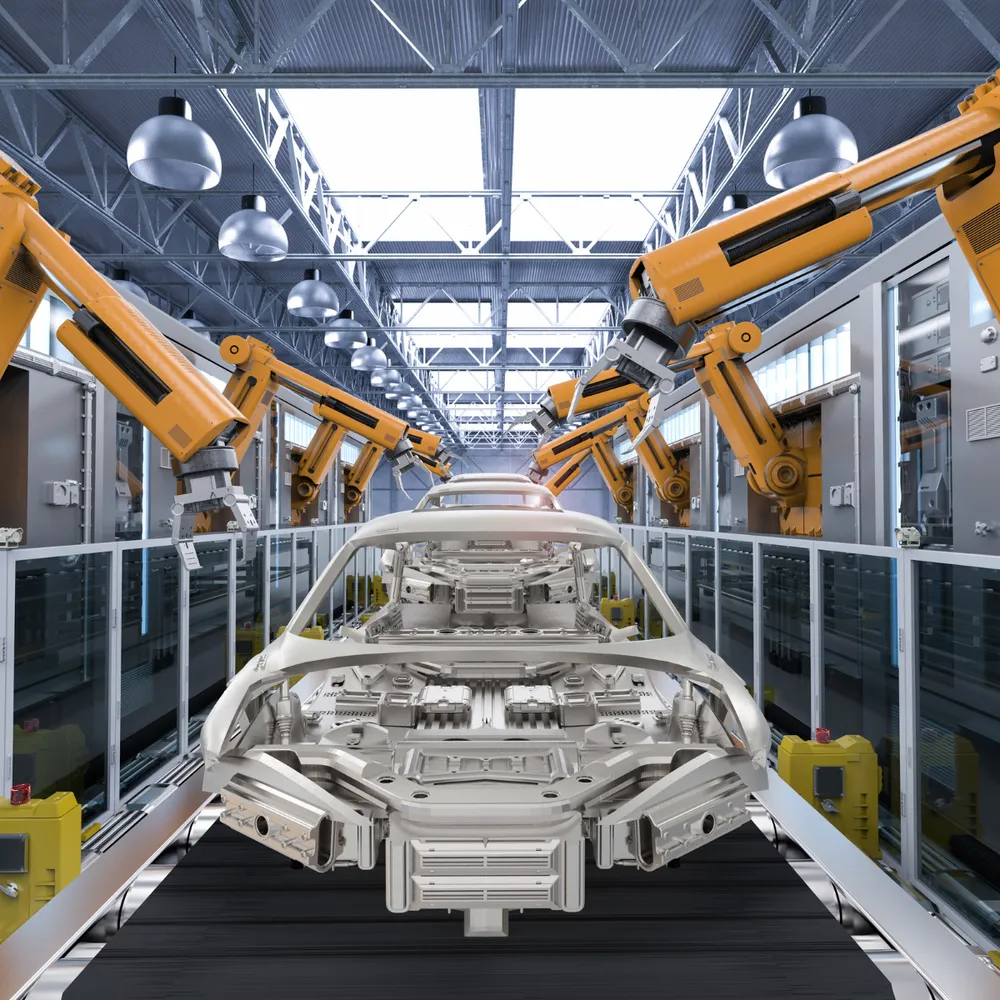
The car plant at Washington has been the anchor for four decades — the UK's highest-volume vehicle factory — and it has pulled a dense automotive supply chain of pressings, plastics, seating and logistics around itself. The next chapter is electric: battery manufacture is scaling alongside the vehicle lines, bringing clean-dry production halls with static control rules. Down on the river, Sunderland's older trades continue — fabrication, marine engineering and offshore work on the Wear — with the Port of Sunderland handling project cargo for North Sea energy.
Two very different dress codes result: the controlled indoor discipline of a production hall, and all-weather steel-toe work where the river wind gets a vote.
Kit by industry
| Local industry | The kit that matters | The spec detail |
|---|---|---|
| Vehicle assembly | Snug-fit polos and trousers, S1P trainers | Line rules: no loose drawcords, covered zips that can't scratch paintwork |
| Battery manufacture | Antistatic garments where zoned | EN 1149-5 — how static-dissipative kit works |
| Supply-chain plants & pressings | Cut-rated gloves, hearing protection, coveralls | EN 388 decoded for pressed-metal edges |
| Marine & offshore fabrication | Welding FR, waterproof hi-vis layers | EN ISO 11611 welding kit over EN 343 shells |
| Port & logistics | Class 2–3 hi-vis, S3 boots | The class call for yards and quaysides |
The detail that matters
A volume assembly hall bans as much as it requires: no exposed metal zips or studs that could scratch a painted body, no loose drawcords near moving track, snug cuffs, and often specific pocket rules on the trim lines. That's why automotive workwear looks the way it does — clean-faced softshells, covered plackets, elastane in the trousers for the constant crouch-and-reach. Buying generic site kit for line work gets it politely handed back at induction.
The battery halls add a layer most of the region hasn't dealt with before: static control. Where zones are designated, garments carry EN 1149-5 and footwear moves to ESD ratings — a spec written by the product's sensitivity rather than the wearer's risk, and checked at the door.
Supply
Questions
Snug-fitting, paint-safe garments: polos and trousers without exposed metal fittings, covered zips, no loose cords near the track, and S1P-type safety trainers for all-day standing on concrete. Individual plants publish their own line rules — the common thread is protecting the product as well as the person.
It's the standard for static-dissipative protective clothing. In battery manufacture and other static-controlled zones, garments carrying EN 1149-5 stop charge accumulating on the wearer — worn as part of a grounded system with ESD footwear. If a hall is zoned for static control, the garment label matters as much as the wrist strap.
Nationwide from central stock, usually on an express service, with embroidery applied before dispatch. Supply-chain plants ordering rotation quantities and contractors kitting mixed crews both run through one trade account.
We supply nationwide from stock — send the roles and headcount and we'll come back with a kit list, embroidered.