iNeedWorkwear

Roles / Welding & Fabrication

Flame-resistant coveralls for welders.

Spatter, radiant heat and molten metal decide what a welder wears — not the job title. Here's the standard you actually need by process, the classes that matter, and how to keep the rating intact wash after wash.

EN ISO 11611
Welding standard
Class 1 / 2
By process
+ IEC 61482
If arc risk
FR COVERALL / HAZARD MAP FR SPATTER RADIANT MOLTEN ARC?
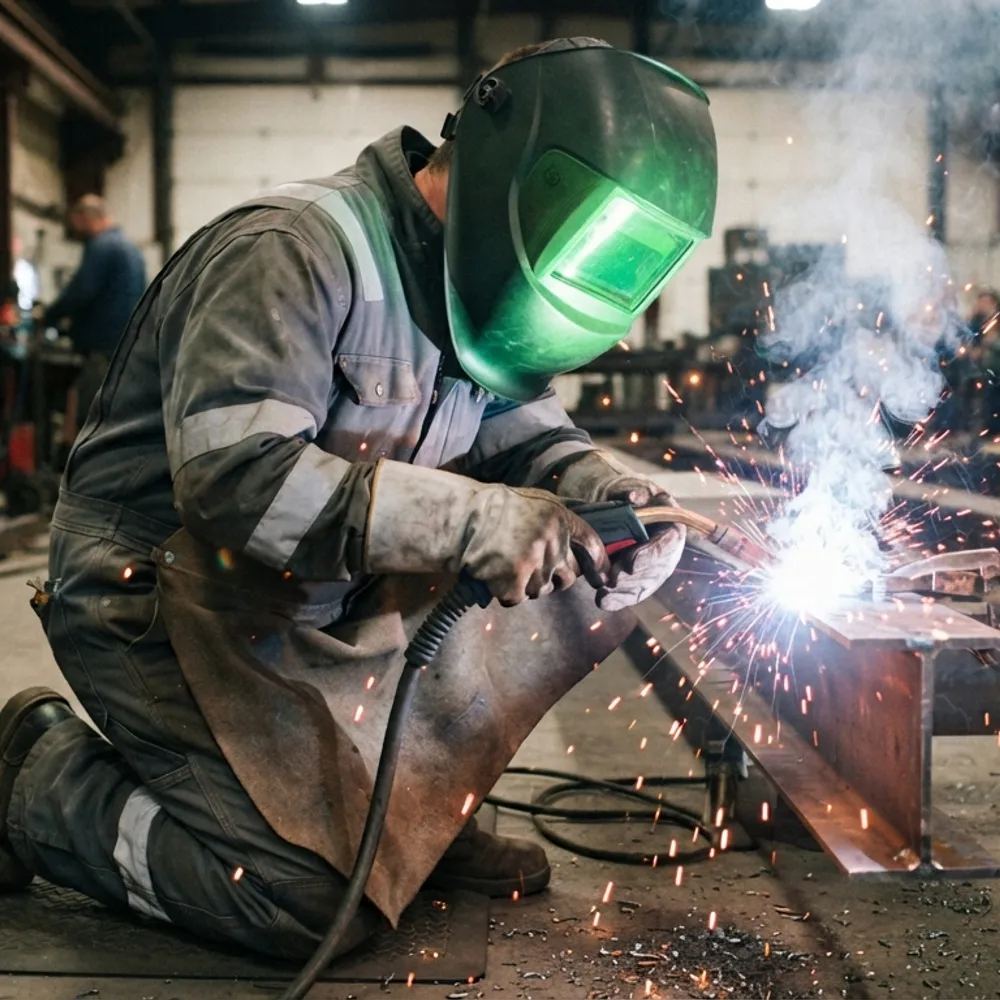
Welder in FR coveralls, leather apron and gauntlets welding a steel beam
EN ISO 11611 explained Class by process Arc & antistatic covered FR care that lasts

Why standard coveralls aren't enough

Four hazards decide a welder's coverall

A poly-cotton work coverall can melt onto skin. Welding kit is chosen against specific, testable hazards — and each maps to a specific standard clause.

Spatter & hot particles

Globules of molten metal thrown from the arc. The garment must resist ignition and let particles roll off, not lodge and smoulder.

EN ISO 11611 — spatter drops

Radiant & convective heat

Sustained heat from the arc and workpiece. Rated by how long the fabric delays heat transfer to the skin.

EN ISO 11611 — RHT / heat

Molten metal splash

Heavy processes shed larger volumes of molten metal — covered by a dedicated code letter for molten iron.

EN ISO 11612 — code E
Only some welders face a fourth hazard — an electric arc — when they also work on or near live equipment. That's a separate standard (IEC 61482), and the finder below tells you whether it applies. Browse FR coveralls certified to EN ISO 11611 →

The standards, plainly

Which mark on the label means what

Four standards cover the welding hazards above. You always need the first; the rest depend on your work.

StandardProtects againstClasses / codesWho needs it
EN ISO 11611
Welding & allied processes
Spatter, short contact with flame, radiant heatClass 1 — lighter processes
Class 2 — heavier processes & more spatter
Every welder
EN ISO 11612
Heat & flame (general)
Flame spread (A), heat (B/C/F), molten metal (D/E)Code letters, e.g. A1 B1 C1 EHeavy welding, molten-metal exposure
IEC 61482
Electric arc
Thermal effects of an arc flashATPV (cal/cm²) or APC 1 / APC 2Welders also working live-electrical
EN 1149-5
Electrostatic
Static discharge in flammable atmospheresSurface resistance / decayFuel, solvent or explosive-atmosphere sites

Note: EN ISO 11611 also carries two heat classes (A1/A2) describing the test method for limited flame spread. The class number (1/2) is the spatter & radiant-heat level — that's the one to match to your process.

Interactive

Welding PPE standard finder

Answer three quick questions. This is genuine utility no supplier feed can copy — and it's the kind of page unit that scales without duplicating.

Standard finder · no data leaves your browser

What does your welding actually need?

Guidance based on EN ISO 11611 process categories. It doesn't replace your site risk assessment — it gets you to the right starting spec.

Your recommended spec
EN ISO 11611 Class 1
Illustrative decision aid for the prototype. Final selection should follow your COSHH / risk assessment and the garment manufacturer's certification.

Choosing the garment

Inherent vs treated FR — the real trade-off

Two coveralls can both say "EN ISO 11611 Class 2" and behave very differently over a year of washes. This is the comparison that actually helps a buyer — built from spec, not marketing copy.

Longest protection

Inherent FR

Flame resistance is built into the fibre (e.g. aramid / modacrylic blends). It cannot wash out.

  • FR lifespanLife of the garment
  • Typical weight330–350 gsm
  • Wash toleranceIndustrial + domestic
  • Upfront costHigher
  • Best forDaily, heavy welders
Lower upfront cost

Treated (FR-finished) cotton

A chemical finish makes cotton flame-resistant. Comfortable, but the finish has a finite life.

  • FR lifespanFinite (per maker's wash count)
  • Typical weight290–320 gsm
  • Wash toleranceStrict — no softener/bleach
  • Upfront costLower
  • Best forOccasional / lighter use
Match the class from the finder to the fabric type here, then shop the shortlist. See EN ISO 11611 Class 2 coveralls →

Keeping the rating

Care that protects the protection

FR clothing fails quietly — a softened, oil-soaked or over-washed coverall can still look fine and no longer protect. The rules are simple and non-negotiable.

Do

  • Wash below the garment's stated maximum temperature
  • Turn inside out and fasten before washing to protect the surface
  • Remove oil, grease and solvent contamination promptly — hydrocarbons are flammable and defeat FR
  • Repair only with FR thread and matching FR fabric
  • Retire treated-FR garments once the maker's wash count is reached

Don't

  • Use fabric softener — it coats fibres and can hold flammable residue
  • Use chlorine bleach — it degrades FR fibres and finishes
  • Wash FR garments with oil-contaminated non-FR workwear
  • Starch, or dry above the stated maximum
  • Assume "looks fine" means "still protects" — track wash cycles

Questions

Welder FR coverall FAQ

What standard do welding coveralls have to meet?

The welding-specific standard is EN ISO 11611, protective clothing for use in welding and allied processes. It has two classes: Class 1 for less hazardous techniques with lower spatter and radiant heat, and Class 2 for more hazardous techniques and heavier spatter. Many welders also need EN ISO 11612 for general heat and flame, and IEC 61482 if there is an electric-arc risk.

What's the difference between EN ISO 11611 Class 1 and Class 2?

The classes reflect how much spatter and radiant heat the garment is tested to withstand. Class 1 suits lighter processes such as TIG and light MIG on a bench. Class 2 is for heavier MIG/MAG, MMA stick welding, overhead work, plasma and gouging, where spatter and molten metal are greater. Class 2 is tested to a higher number of spatter drops and a higher radiant-heat transfer.

Can I wash FR welding coveralls at home?

You can, but the rules matter more than the machine. Never use fabric softener or chlorine bleach — both can coat or degrade the fibres and mask or reduce flame resistance. Wash below the garment's stated maximum temperature, keep FR garments away from oil- and solvent-contaminated items, and repair only with FR thread and fabric. Treated-cotton FR has a finite number of washes; inherent FR keeps its protection for the life of the garment.

Do welders need arc-rated clothing?

Only if there is an electric-arc hazard — for example working on or near live electrical equipment as well as welding. Arc protection is covered by IEC 61482 (arc rating expressed as ATPV or as arc protection class APC 1 or 2), which is separate from the welding standard EN ISO 11611. Pure welding without an electrical hazard does not by itself require arc-rated clothing.
Kit your welders out right

Match the standard from the finder to a certified garment — and add embroidery, sizing and trade-account ordering in the shop.