iNeedWorkwear
Areas hub / Northampton

Area guide · Northampton

Workwear in Northampton: from last to loading bay.

Northampton still makes some of the world's finest shoes — working factories, not museums — while the fields around the M1 filled with some of Britain's biggest distribution sheds. A town that cuts leather by hand in the morning and moves a million parcels by night needs two very different kit lists, and no one else's guide covers the first one.
Since 1800s
Working shoe factories, still cutting
M1 J15–16
The distribution corridor
2 trades
Bench craft and big sheds
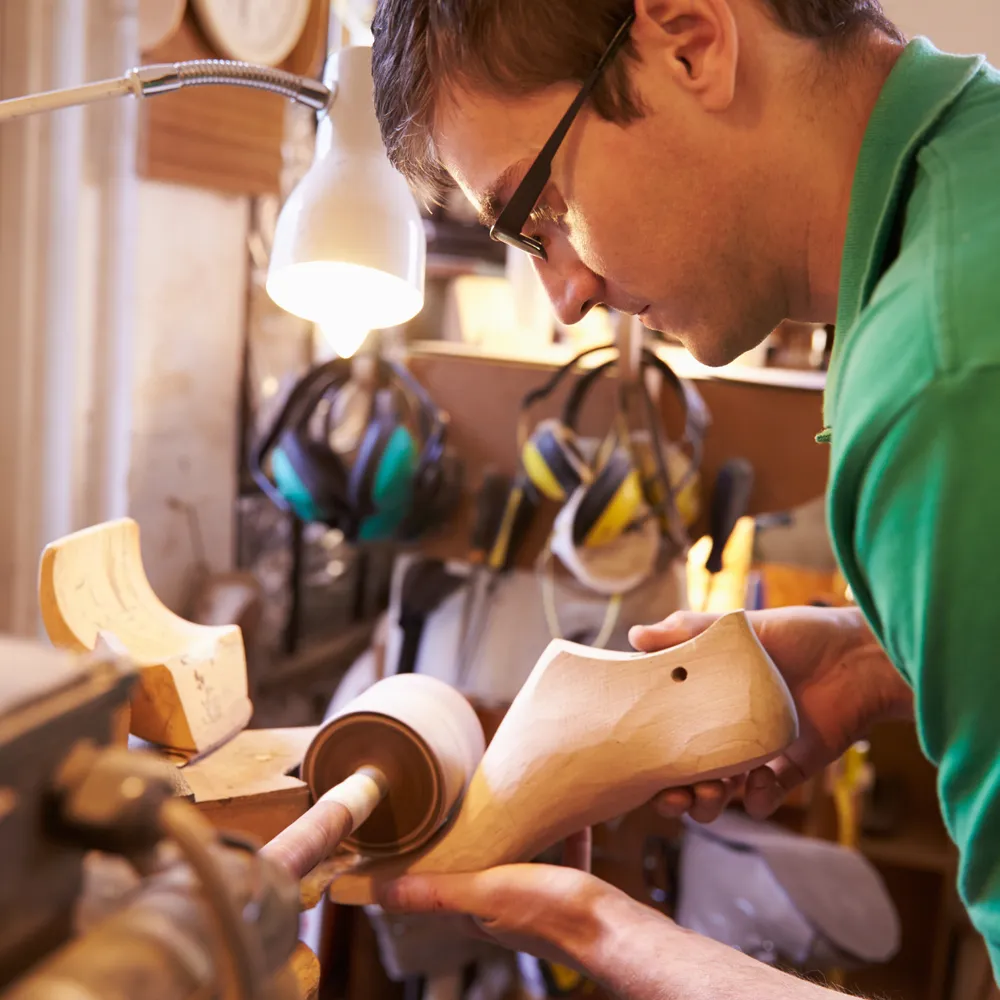
Shoemaker shaping a wooden last at the bench
Kit matched to the local economy Standards named, not implied Fast nationwide supply Embroidery & trade accounts

The local economy

What Northampton actually does

The welted-shoe trade survives here at genuine scale for a craft industry: clicking (cutting), closing, lasting and finishing rooms where knives, presses and solvents are daily tools. Around it, engineering and manufacture — lifts, automotive components, print — and above all distribution: the M1 corridor through Northamptonshire carries one of the densest concentrations of warehousing in Europe, from parcel hubs to fashion fulfilment. County-town services, construction and a large healthcare base round out the wardrobe.

Kit by industry

The Northampton kit map

Local industryThe kit that mattersThe spec detail
Shoe factories — clicking & bench workAprons, cut-resistant gloves for knife workCut letters — blade work wants level C thinking
Finishing & solvent areasNitrile gloves, FFP where extraction is localFFP ratings for adhesive vapour zones
Engineering & componentsFitted kit, S1P footwearOil-day laundering
Distribution & parcel hubsHi-vis, cushioned S1P trainers, layersKit by zone
Construction & tradesClass 2 hi-vis, helmets, S3 bootsThe baseline

The detail that matters

Craft trades buy comfort; sheds buy miles

A clicker spends the day standing at a board driving a knife through hide — the kit that matters is a proper apron, a cut-aware glove on the steadying hand (the knife hand usually stays bare for feel), good light and footwear that forgives eight standing hours. It's a wardrobe about precision and endurance rather than certified hazards, with one exception: solvent and adhesive stations, where nitrile and ventilation rules apply just as they would in any factory.

The distribution economy inverts the priorities: a picker walks 15–20 km per shift, so cushioned S1P trainers are the highest-value item on the list, ahead of the hi-vis everyone remembers and the chilled-section layers some sites add. Buy footwear like it's the tool it is.

Supply

How we supply Northampton

Craft & scale
Bench aprons and thousand-unit shed orders alike
From stock
Trainers, hi-vis and layers express
Trade accounts
Factories and 3PLs reorder without friction

Questions

Northampton kit FAQ

What gloves do leather workers use?

For clicking and knife work, typically a cut-resistant glove on the steadying hand while the knife hand stays bare for feel — ISO 13997 level C thinking for the exposed hand. At solvent and adhesive stations the need switches to chemical-resistant nitrile. Task, not trade, picks the glove.

What's the best footwear for warehouse picking?

Cushioned S1P safety trainers — toe protection and midsole puncture resistance in a construction built for the 15–20 km a picker walks per shift. In distribution, footwear quality shows up directly in fatigue and absence; it's the item worth buying best.

Do you supply Northampton's shoe factories?

We supply nationwide from stock — aprons, gloves, nitrile and FFP consumables for the bench trades alongside embroidered factory kit. The craft rooms' needs are specific but simple, and a trade account keeps them on repeat.

Kitting a team out here?

We supply nationwide from stock — send the roles and headcount and we'll come back with a kit list, embroidered.