Care & maintenance · Flame-resistant
Flame-resistant clothing fails quietly. A softened, oil-soaked or over-washed coverall can look perfectly fine and no longer protect the person wearing it. The good news: the rules are simple, and they matter more than the machine. Here's how to wash FR kit so it stays compliant.

The short answer
Flame resistance isn't like ordinary durability. It's a specific property — built into the fibre (inherent FR) or applied as a finish (treated FR) — and a handful of everyday laundry habits can strip it out without leaving any visible sign. Fabric softener and chlorine bleach are the big two, but hydrocarbon contamination and hard-water deposits do it too.
Get the wash right and an inherent-FR coverall protects for its whole working life. Get it wrong and you can turn a certified garment into ordinary — flammable — clothing in a single cycle.
Step by step
Note the maximum wash temperature, and for treated-FR garments the maximum number of wash cycles the flame resistance is rated for. Inherent FR has no wash limit; treated FR does.
Remove oil, grease and fuel promptly — hydrocarbons are flammable and defeat FR no matter how good the fabric is. Heavily contaminated garments usually need professional / industrial laundering rather than a domestic machine.
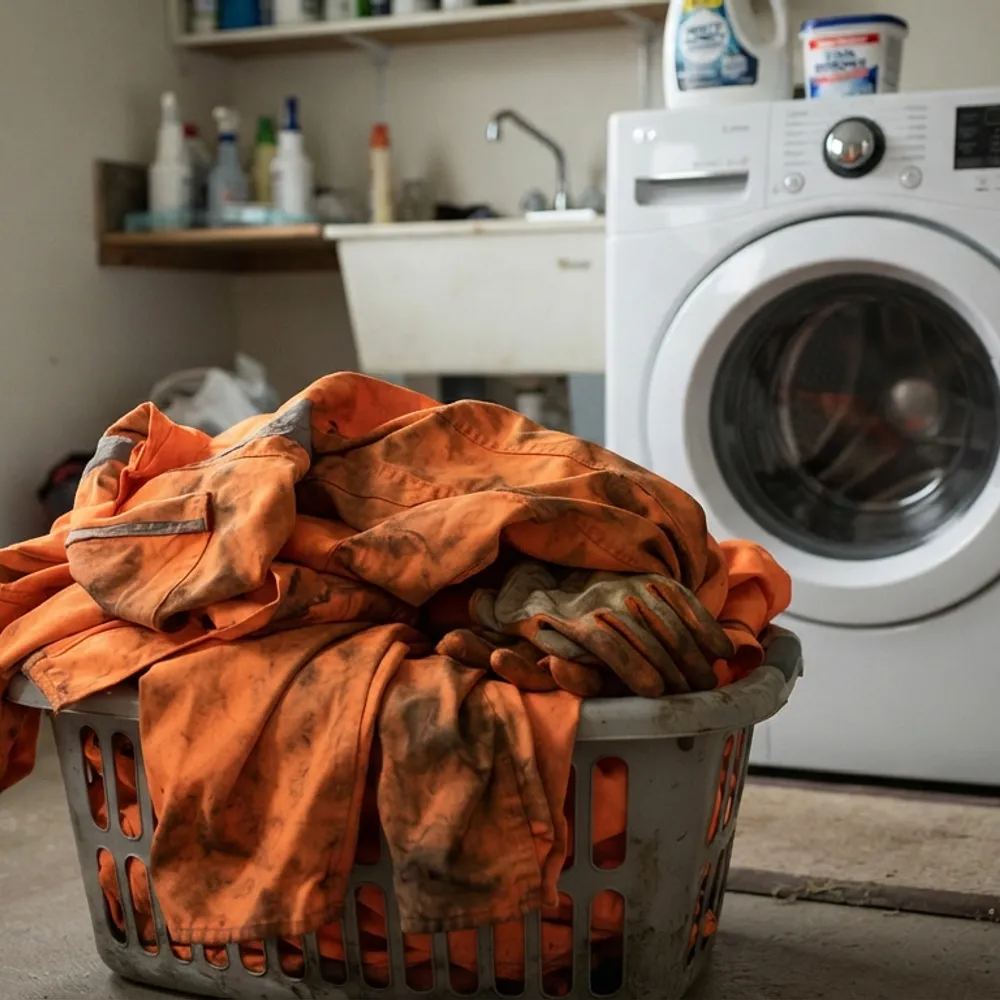
Empty the pockets, close all zips and studs, and turn the coverall inside out to protect the outer surface and any reflective tape. Wash FR separately from oily non-FR workwear to avoid transferring residues.
Wash below the stated maximum temperature with a normal detergent. No fabric softener, no chlorine bleach, no starch. In hard-water areas, rinse thoroughly to limit mineral build-up that can reduce FR over time.
Dry as the label directs and avoid excessive heat — don't over-dry. Correct drying protects both the fabric and any finish.
Check for damage, thinning and contamination. Repair only with FR thread and matching FR fabric — a non-FR patch is a hole in the protection. Retire the garment once the FR is compromised, or once a treated-FR garment reaches its wash-cycle limit.
At a glance
Quick reference
| Product / setting | FR coveralls? | Why |
|---|---|---|
| Normal detergent | Yes | Cleans without harming the fibre or finish |
| Fabric softener | No | Flammable film; masks/reduces FR |
| Chlorine bleach | No | Degrades FR fibres and finishes |
| Starch | No | Adds a flammable coating |
| Wash temperature | Below max | Protects the fabric and any FR finish |
| High-heat tumble dry | No | Over-drying can damage fabric/finish |
Why lifespan differs
Inherent FR is engineered into the fibre itself (e.g. aramid or modacrylic blends). It can't wash out, so with correct care it protects for the life of the garment. Treated (FR-finished) cotton gets its flame resistance from a chemical finish, which has a finite life — the maker rates it for a maximum number of washes, after which it should be retired even if it still looks and feels fine.
That single difference decides your replacement budget: inherent FR costs more up front but lasts; treated FR is cheaper but is a consumable on a wash count.
Questions
Fabric softener coats the fibres with a film that can be flammable and can mask or reduce the garment's flame resistance. It's one of the most common ways FR clothing is unknowingly compromised in the wash, so softener should never be used — including in the rinse cycle or as a dryer sheet.
It depends on the fabric. Inherent FR is built into the fibre and keeps its protection for the life of the garment. Treated (FR-finished) cotton has a chemical finish with a finite life, rated for a maximum number of washes on the label — after which it should be retired even if it looks fine.
Avoid it. Washing FR garments with oil- or solvent-contaminated non-FR workwear can transfer flammable residues onto the FR fabric, undermining its protection. Wash FR separately, and deal with heavy hydrocarbon contamination before it goes in the machine.
It can. Hard water and some soap-based detergents leave mineral deposits on the fabric that build up over time and can reduce flame resistance. Use a suitable detergent, rinse thoroughly, and in hard-water areas consider measures to limit deposit build-up.
FR coveralls to EN ISO 11612 and EN ISO 11611, inherent or treated, embroidered and on trade accounts.